Wedding Florist Pricing: The Math Behind Profitable Proposals

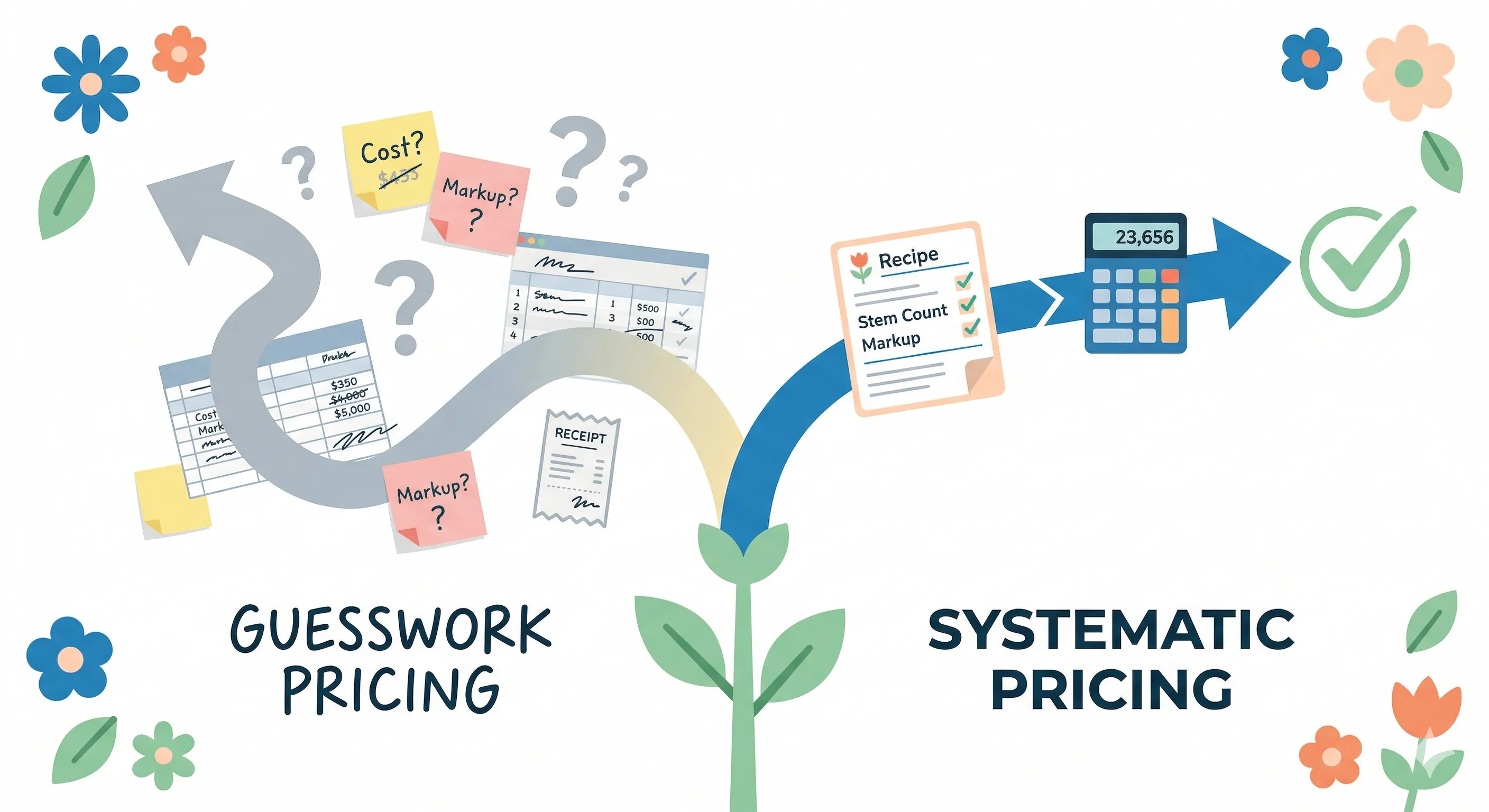
Most wedding florists learned their pricing the same way — someone told them “multiply wholesale by three” and they never questioned it again. That formula might keep the lights on when you’re doing five weddings a year. But once volume picks up, once the proposals stack, once you’re juggling six active events with different flower markets, three rounds of revisions each, and a client who wants “just a few more centerpieces” without adjusting the budget — the cracks in that pricing foundation start to show.
The real problem isn’t that florists don’t know the formulas. It’s that the formulas, by themselves, don’t account for the operational reality of running a growing event floral business. And that gap between “formula on paper” and “profit in the bank” is where most wedding florists lose money without ever realizing it.
This guide is built for the florist who is past the startup phase, doing real wedding volume, and ready to price with precision instead of hope.
The Industry Standard Formula (And Why It’s Only the Starting Point)
The widely accepted pricing formula for wedding and event florals is straightforward. Take the wholesale cost of flowers and sundries (ribbon, wire, foam or alternatives, tape, vessels), multiply by 3.5 to 4.5, and then add a labor or design fee of 30 to 50 percent on top.
So a bridal bouquet with $60 in wholesale flowers and materials, multiplied by 3.5, comes to $210. Add a 40 percent labor markup and the client price lands at $294.
That formula works. It’s been validated by thousands of florists, recommended by educators like Alison Ellis of Real Flower Business, and forms the backbone of pricing guides across the industry. If you’re currently pricing below that range, adjusting to it should be your first move.
But here’s what that formula doesn’t tell you.
It doesn’t account for the three hours you spent sourcing availability for that one variety the bride saw on Pinterest. It doesn’t include the two rounds of revisions where you rebuilt the proposal from scratch because the guest count changed. It doesn’t factor in the 45 minutes you spent driving to the venue for a site visit, or the four staff hours for setup, breakdown, and cleanup.
The formula prices the product. It does not price the operation.
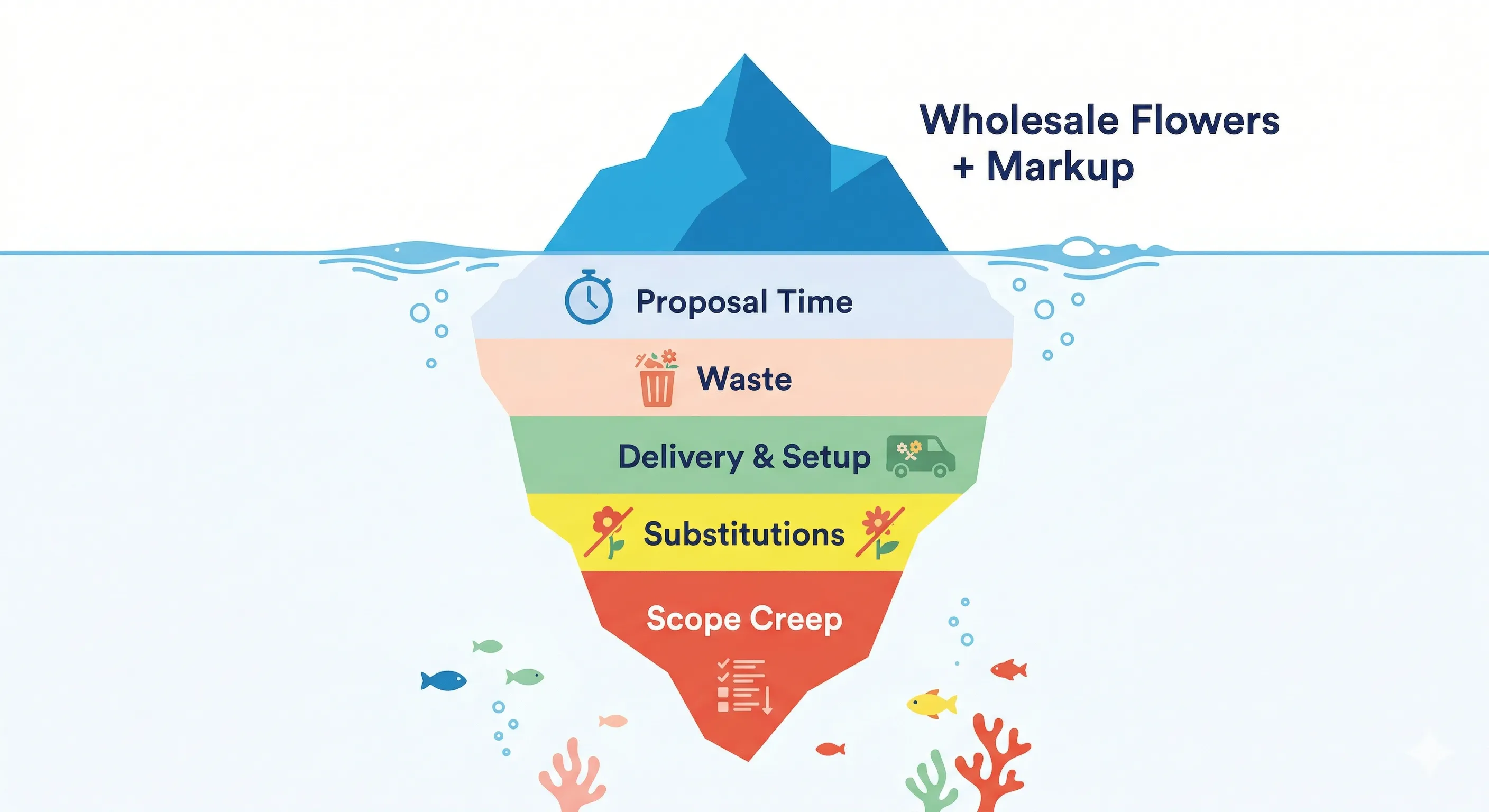
The Five Hidden Costs That Eat Your Margins
Once you move past the basic formula, the real pricing challenge is capturing the operational costs that most florists absorb without tracking. These are the silent margin killers:
1. Proposal and revision time. The average event florist spends two to four hours building a single wedding proposal. If that proposal goes through three rounds of client revisions — which is normal in the wedding space — total time investment can reach six to eight hours before the contract is even signed. If you’re closing one out of every three proposals, that means you’re spending 18 to 24 hours of uncompensated time for every wedding you book. At even a modest $50/hour value of your time, that’s $900 to $1,200 in hidden cost per booked event.
2. Waste and overordering. Wedding florists typically overbuy by 15 to 25 percent to insure against stem damage, color variation, and last-minute changes. That buffer is necessary — but it’s a cost that needs to be priced into the final number, not absorbed as a loss. If your wholesale bill for a $5,000 wedding is $1,400 and you waste 20 percent, that’s $280 in product cost that disappears after the event.
3. Delivery, setup, and breakdown labor. Many florists quote delivery as a flat fee — $150 for local, $300 for a distant venue. But the actual cost depends on vehicle time, staff hours, tolls, loading, unloading, setup complexity, and breakdown/cleanup. A wedding install requiring four staff members for three hours of setup and one hour of breakdown is 16 labor hours. At $25/hour, that’s $400 in labor alone — before the van, fuel, or wear on rental inventory.
4. Substitution risk. Wholesale flower availability changes constantly. When a variety becomes unavailable two weeks before the wedding, you either source it at a premium from a different supplier or substitute with a comparable bloom — which may cost more than the original. That price difference rarely makes it into the client invoice because the contract is already signed.
5. Scope creep. The client asks for “just a few extra bud vases for the cocktail hour” or “can we add greenery to the cake table?” These additions feel small in isolation. But across a 40-wedding season, uncaptured scope creep can represent thousands of dollars in unpriced labor and materials.
The Profitable Pricing Framework
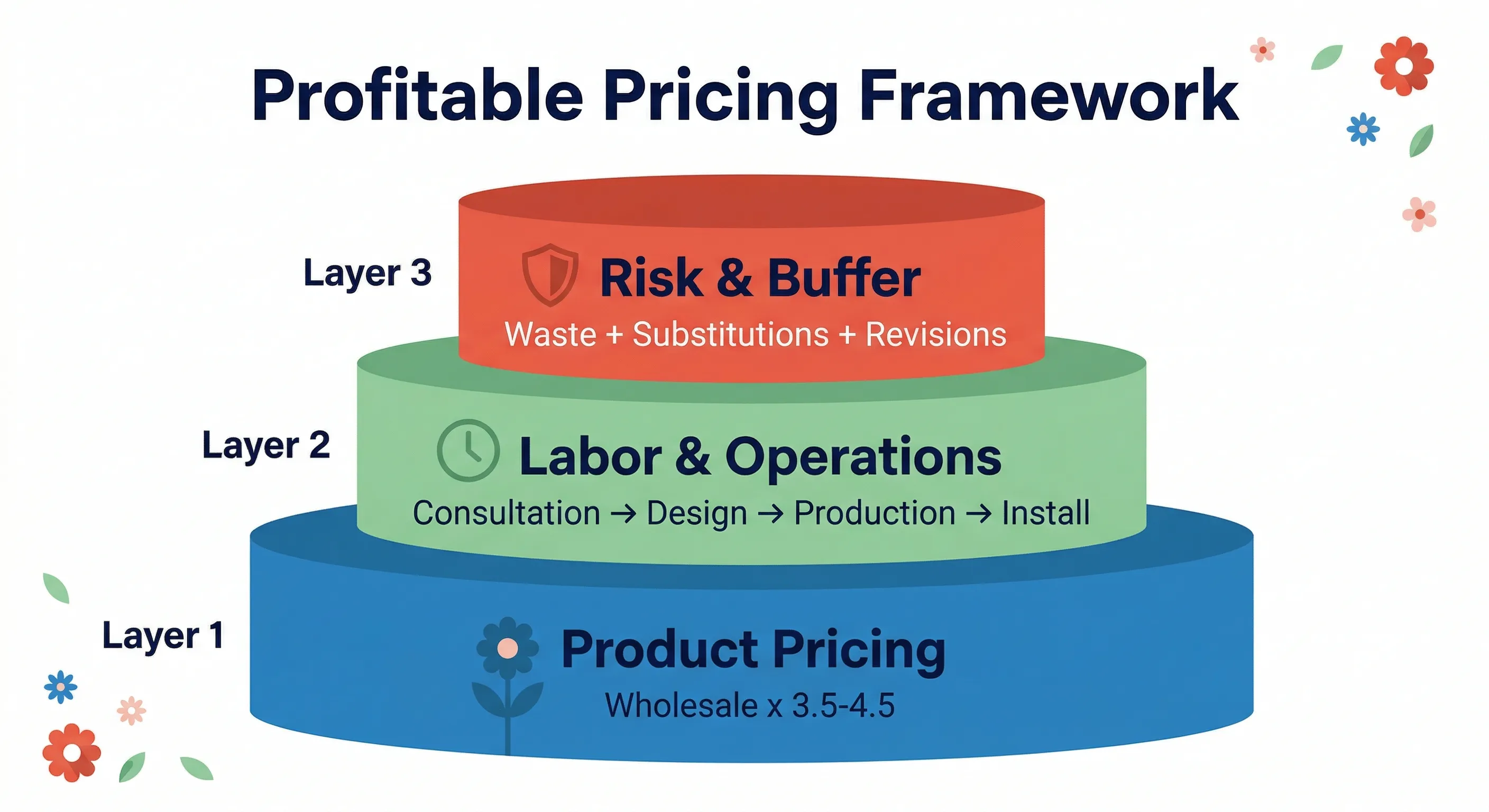
Instead of relying on a single formula, the most profitable event florists use a layered approach. Think of it as pricing in three stages: product, labor, and risk.
Layer 1: Product Pricing
This is the familiar formula. Wholesale cost of all flowers, foliage, and sundries multiplied by your markup factor. For wedding and event work, the industry range is 3.5x to 4.5x wholesale, depending on your market, positioning, and overhead structure. Florists in higher cost-of-living markets or those positioned in the luxury segment often price at 4x to 5x.
The key discipline here is pricing every stem, not rounding down. If a recipe calls for 36 roses at $1.80 wholesale each, that’s $64.80 — not “about $60.” Over a full wedding with 15 to 20 recipes, those small roundings compound into hundreds of dollars of lost margin.
Layer 2: Labor and Operations Pricing
This is where most florists leave money behind. Labor should be priced explicitly, not buried in the markup. Calculate your effective labor rate (total compensation including benefits and overhead, divided by productive hours) and apply it to every phase of the event lifecycle: consultation, design and sourcing, proposal creation, revisions, production, delivery, setup, event management if applicable, breakdown, and cleanup.
A useful benchmark: total labor typically runs 25 to 35 percent of the final event price for a well-run studio. If your labor cost is consistently above 35 percent, either your markup is too low or your production process needs streamlining.
Layer 3: Risk and Buffer Pricing
This is the layer that separates profitable studios from busy-but-broke ones. Build a buffer into every proposal that accounts for waste (15 to 20 percent of wholesale), substitution risk (5 to 10 percent), and a revision allowance.
One effective approach is to include a stated number of revisions in your contract — two rounds is standard — and price additional revisions as a line item. This does two things: it protects your time and it signals to the client that revisions have a cost, which naturally reduces the number of revision rounds.
How to Present Pricing Without Losing the Client
Knowing the math is one thing. Communicating it is another.
The biggest fear florists have about pricing accurately is that the number will scare the client away. That fear drives chronic underpricing — quoting what feels “safe” instead of what’s actually profitable.
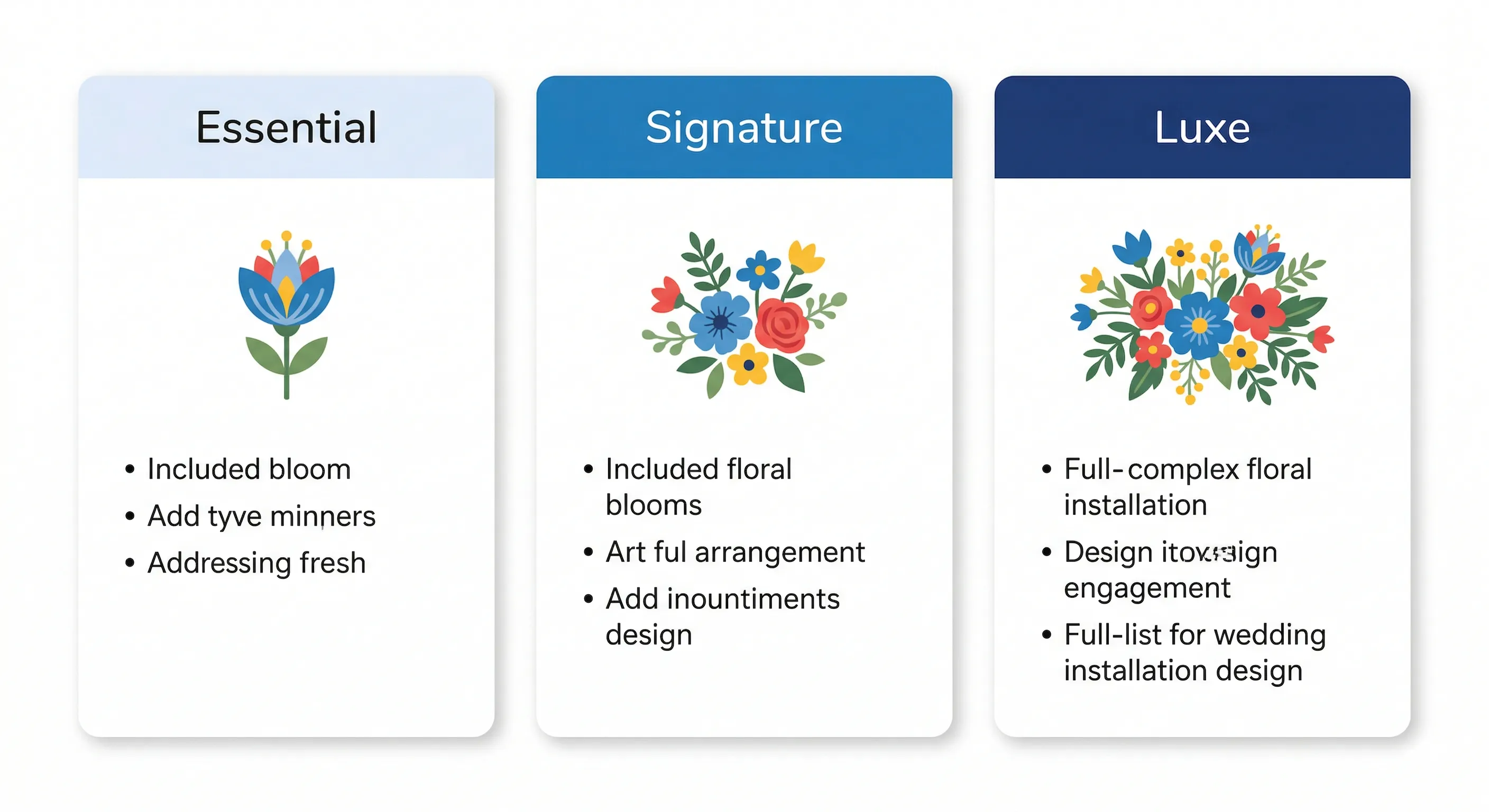
The most effective approach is tiered pricing, often called the Good-Better-Best framework. Present three options at different price points, each clearly defined by what’s included:
The first tier covers the essentials — personal flowers, a ceremony focal piece, and simple reception centerpieces. It should be profitable at your standard markup and represent the minimum scope you’re willing to take on.
The second tier adds impact — upgraded varieties, more complex centerpieces, additional ceremony elements. This is typically your target tier and where most clients land when presented with all three options.
The third tier is the full vision — installations, premium blooms, extended rentals, and enhanced design complexity. This tier exists partly to make the second tier feel reasonable by comparison.
The psychology behind tiered pricing is well documented. When given three options, most buyers choose the middle one. By anchoring the conversation around three defined packages rather than an open-ended custom quote, you control the pricing narrative while giving the client a sense of choice.
Pricing by Event Type: Not All Weddings Are Equal
A 250-guest ballroom wedding with a floral arch, 25 centerpieces, and cocktail installations is a fundamentally different operation than a 50-guest garden wedding with a bridal bouquet, six table arrangements, and a simple ceremony marker.
Your pricing should reflect that difference not just in materials but in complexity, logistics, and risk.
Consider building your pricing structure around event tiers based on operational complexity rather than just flower count. A useful framework divides events into three categories:
Standard events have a predictable scope, familiar venue, straightforward logistics, and minimal custom design requirements. These can be priced using your standard formula with confidence.
Complex events involve custom installations, multiple venues or ceremony-to-reception transitions, challenging logistics (outdoor in summer, destination, venues with loading restrictions), or clients requiring extensive design consultation. These warrant a complexity premium of 10 to 20 percent above your standard pricing.
High-touch events are the large-scale, luxury productions requiring dedicated project management, multiple site visits, vendor coordination beyond the typical scope, and the kind of detailed client communication that essentially becomes a part-time job. These should be priced on a project basis rather than a per-arrangement basis, with a project management fee built in.
The Recipe-Level Pricing Discipline
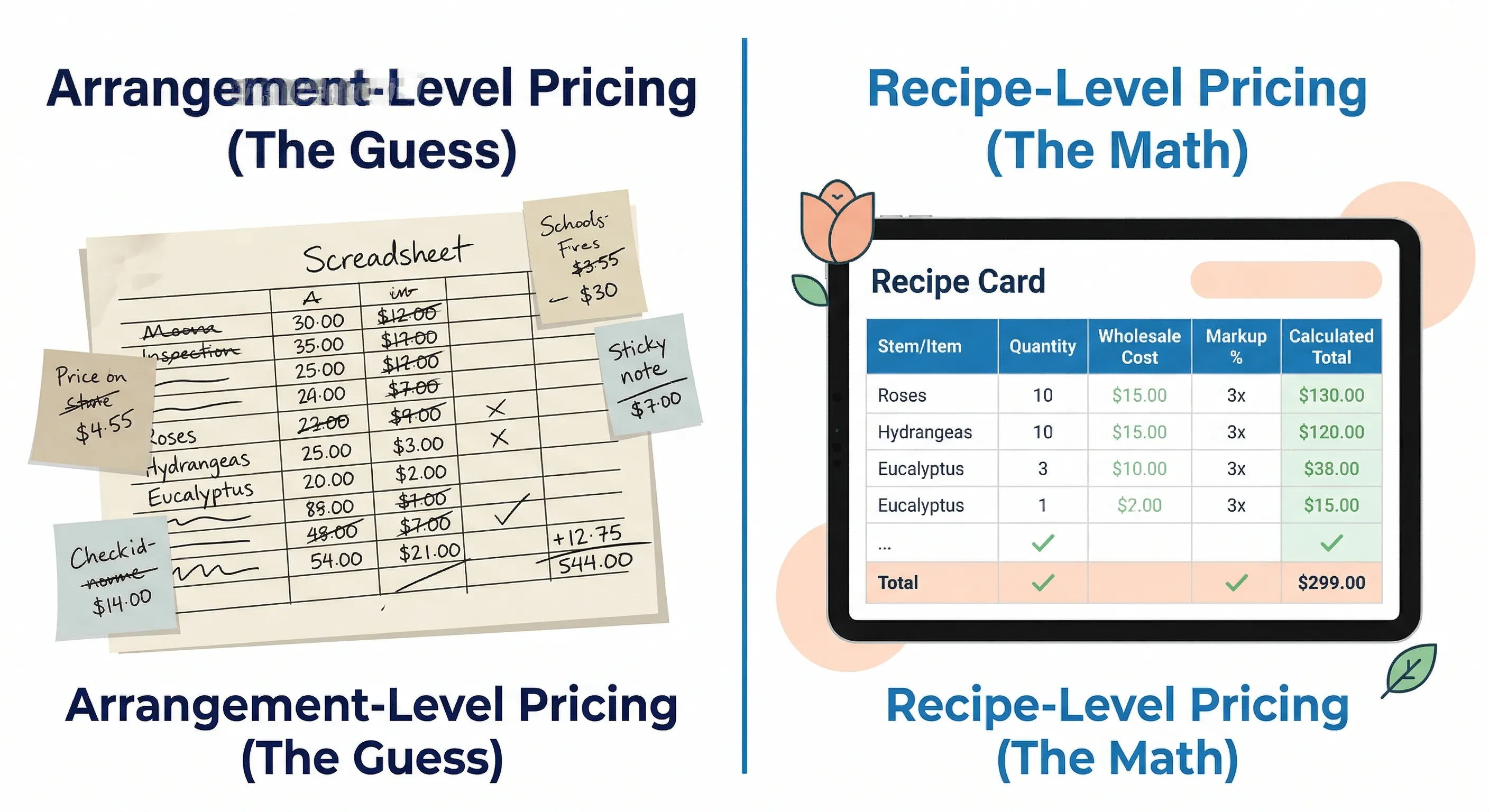
The single most impactful change a wedding florist can make to their pricing accuracy is moving from arrangement-level pricing to recipe-level pricing.
Arrangement-level pricing means looking at a centerpiece design and estimating “that’s about a $175 centerpiece.” It’s fast, but it’s a guess — and guesses compound across 20 tables into real money.
Recipe-level pricing means listing every stem, every piece of foliage, every sundry item in the recipe, applying your wholesale cost and markup to each one, and calculating the exact price of that specific arrangement. When you do this consistently, two things happen: you stop underpricing complex designs, and you start seeing exactly where your margin lives in every event.
This is also where software becomes a genuine operational advantage rather than a nice-to-have. Building recipes by hand in a spreadsheet works for five weddings a year. At 30 or 40 weddings, the time cost of manual recipe building, updating wholesale prices, recalculating when substitutions happen, and regenerating proposals after revisions becomes a bottleneck that directly impacts how many events you can handle — and how accurately you price each one.
What Profitable Florists Do Differently
After working with hundreds of event florists, patterns emerge in how the most profitable studios approach pricing differently from those who stay busy but never seem to get ahead.
They price before they design. Profitable florists establish the budget range before investing creative time. If a client’s budget is $3,000 and your minimum for their venue and guest count is $5,000, that conversation needs to happen before you spend four hours building a proposal.
They track actual costs against quoted costs. After every event, profitable florists compare what they quoted to what they actually spent on wholesale, labor, and logistics. This post-event audit is the single best tool for improving pricing accuracy over time.
They standardize their recipe library. Rather than starting from scratch on every proposal, they build a library of tested recipes with known costs and margins. When a new inquiry comes in, they assemble the proposal from proven components, adjusting for the specific event rather than reinventing the wheel.
They charge for the full lifecycle. Consultation, design, production, delivery, setup, breakdown, cleanup — every phase has a cost, and profitable florists capture every one.
They use change order processes. When a client requests additions or modifications after the contract is signed, the request goes through a formal change order with pricing attached. This eliminates scope creep and trains clients to respect the agreed scope.
Building Your Pricing Calculator
To put this framework into practice, you need a system that handles the math consistently across every proposal. Whether that’s a well-built spreadsheet or purpose-built software, the pricing engine should capture these inputs for every event:
Wholesale cost per stem and per sundry item, multiplied by your markup factor. Labor hours by phase (design, production, setup, breakdown), multiplied by your effective labor rate. Delivery and logistics costs based on venue distance, vehicle needs, and staff count. A waste buffer of 15 to 20 percent on perishable items. A revision allowance or complexity adjustment where warranted.
When those inputs are systematized, every proposal you send is built on real math — not memory, not habit, and not the fear that your number is “too high.”
Want to see how markup impacts your margins? Use our free Floral Markup Calculator to test different markup percentages and see exactly how they affect your profit on any arrangement. Plug in your wholesale costs, adjust your markup, and get instant clarity on whether your pricing math actually works.
Try the Free Floral Markup Calculator →
Curate helps event florists build proposals faster, price at the recipe level, and manage revisions without the chaos. If your pricing system is still living in spreadsheets and email threads, see how Curate works for wedding florists →