Floral Proposals: How to Present Options Without Overwhelming Clients
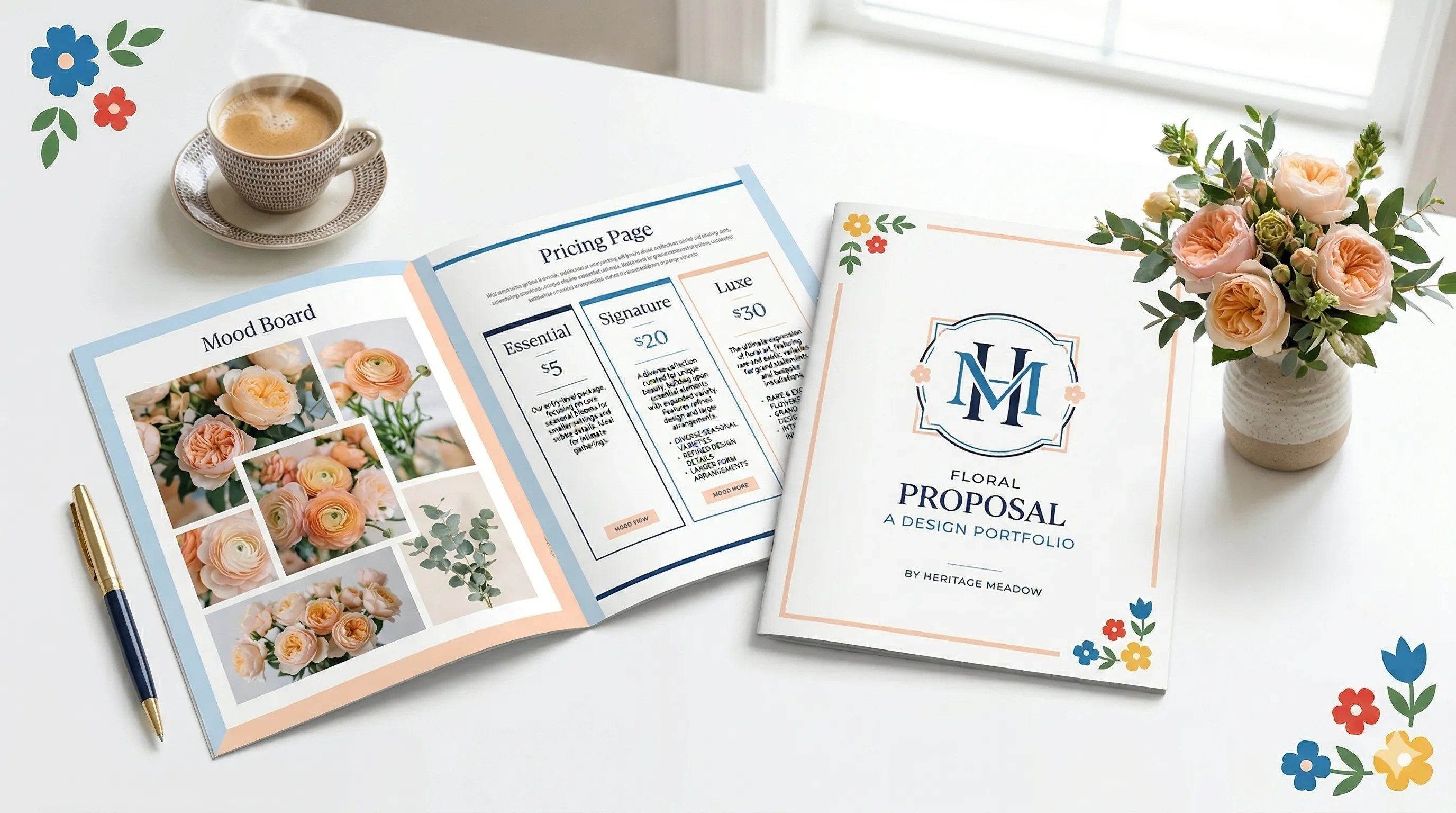
Here’s a scenario most wedding florists know too well. A couple reaches out after their consultation, excited about working with you. You spend three hours building a detailed proposal — pulling inspiration images, listing out every arrangement by location, pricing each piece individually, and writing thoughtful descriptions for 15 different line items. You send it over feeling proud of the work.
Then silence. A few days later, a polite email: “We loved everything, but we’re still deciding. Can we think about it?”
What happened? In most cases, the proposal didn’t fail because the work was bad or the price was too high. It failed because the client was overwhelmed. Too many choices, too much detail, and no clear path to a decision.
The most effective floral proposals don’t present every possible option. They present a curated set of choices that make saying yes easy and saying “let me think about it” unnecessary.
This guide covers the framework that makes that happen — and why the tool you use to build proposals matters just as much as the strategy behind them.
Why Most Floral Proposals Don’t Convert
The instinct to put everything in the proposal makes sense. You want the client to see that you’ve listened, that you understand their vision, and that you’ve thought through every detail. More detail should equal more trust, right?
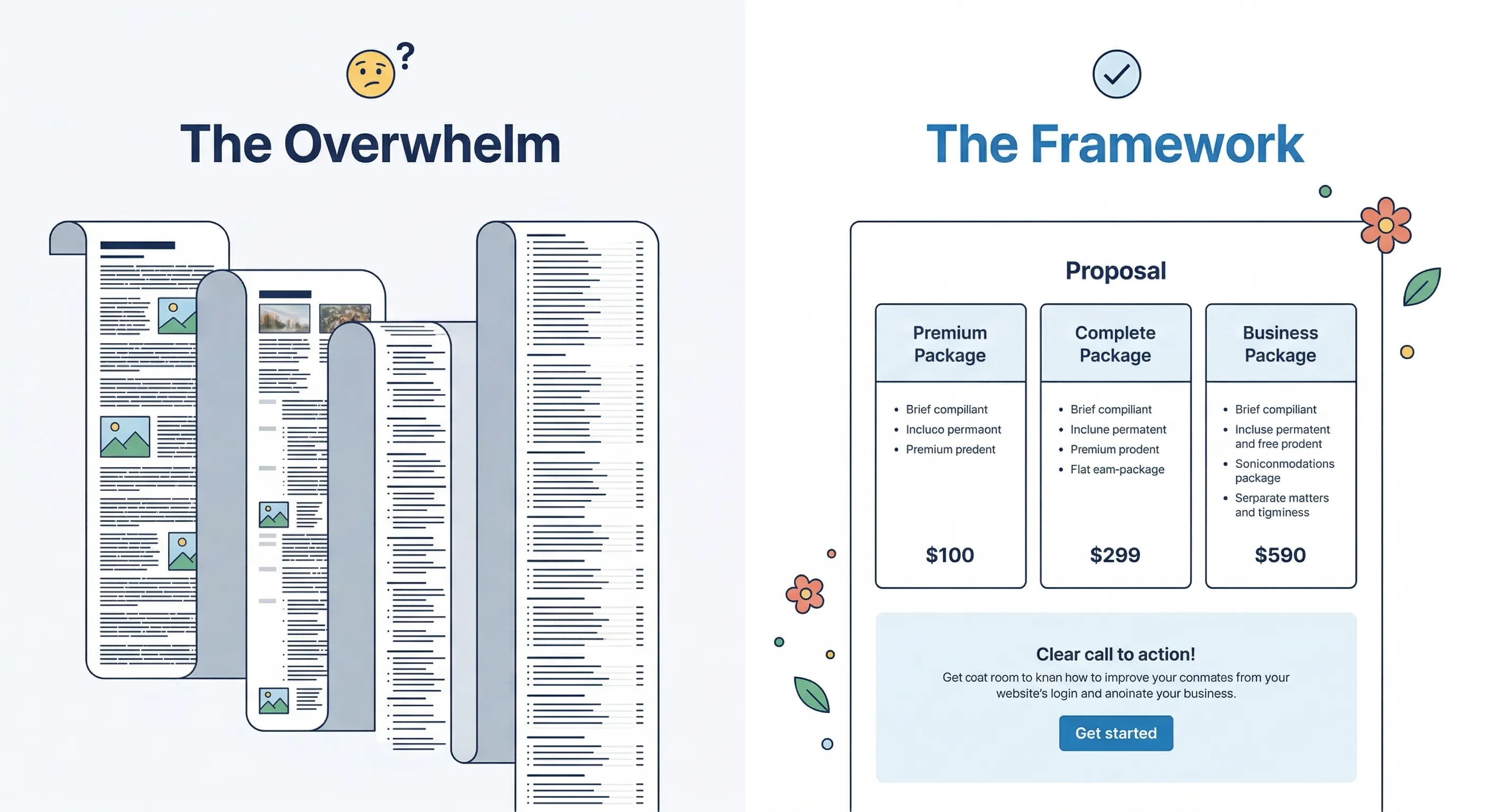
In practice, the opposite happens. Research on consumer decision-making consistently shows that when people are presented with too many options, they’re less likely to choose any of them. Psychologists call this the paradox of choice — and it plays out in floral proposals constantly.
A proposal with 18 line items, each individually priced, each with its own description and image, asks the client to make 18 separate decisions. Do I want the ceremony arch or the ceremony garland? What about the aisle markers — do I need six or eight? Should the cocktail hour have three arrangements or five?
Every additional decision creates friction. Friction creates delay. Delay kills bookings.
The florists who close faster aren’t necessarily better designers. They’re better editors. They structure proposals that guide the client toward a decision instead of handing them a catalog and hoping they figure it out.
The Good-Better-Best Framework
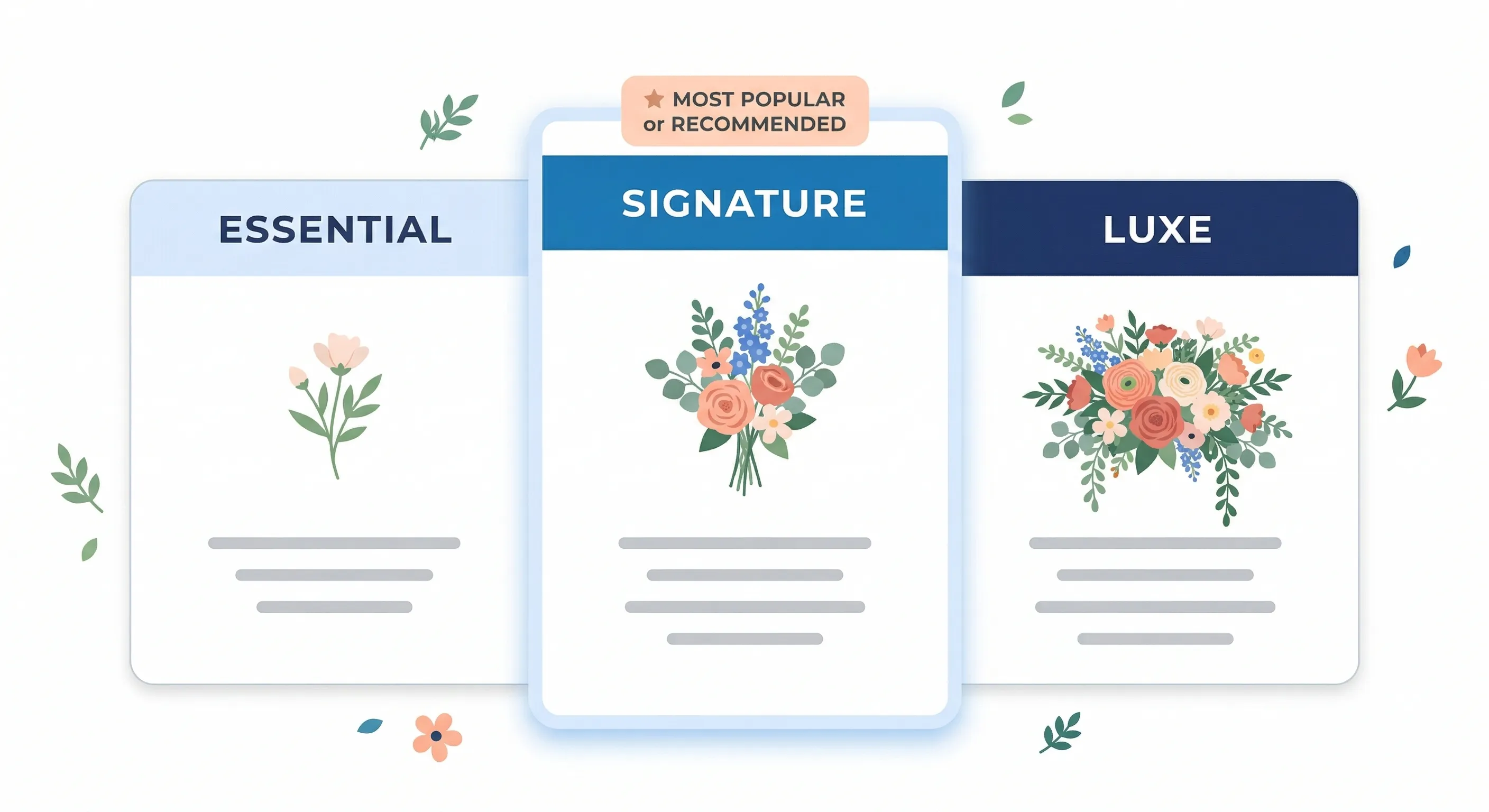
The most effective proposal structure in event florals — and in most service-based businesses — is the tiered approach, commonly called Good-Better-Best. Instead of presenting every individual element as a separate line item decision, you present three complete packages at different investment levels.
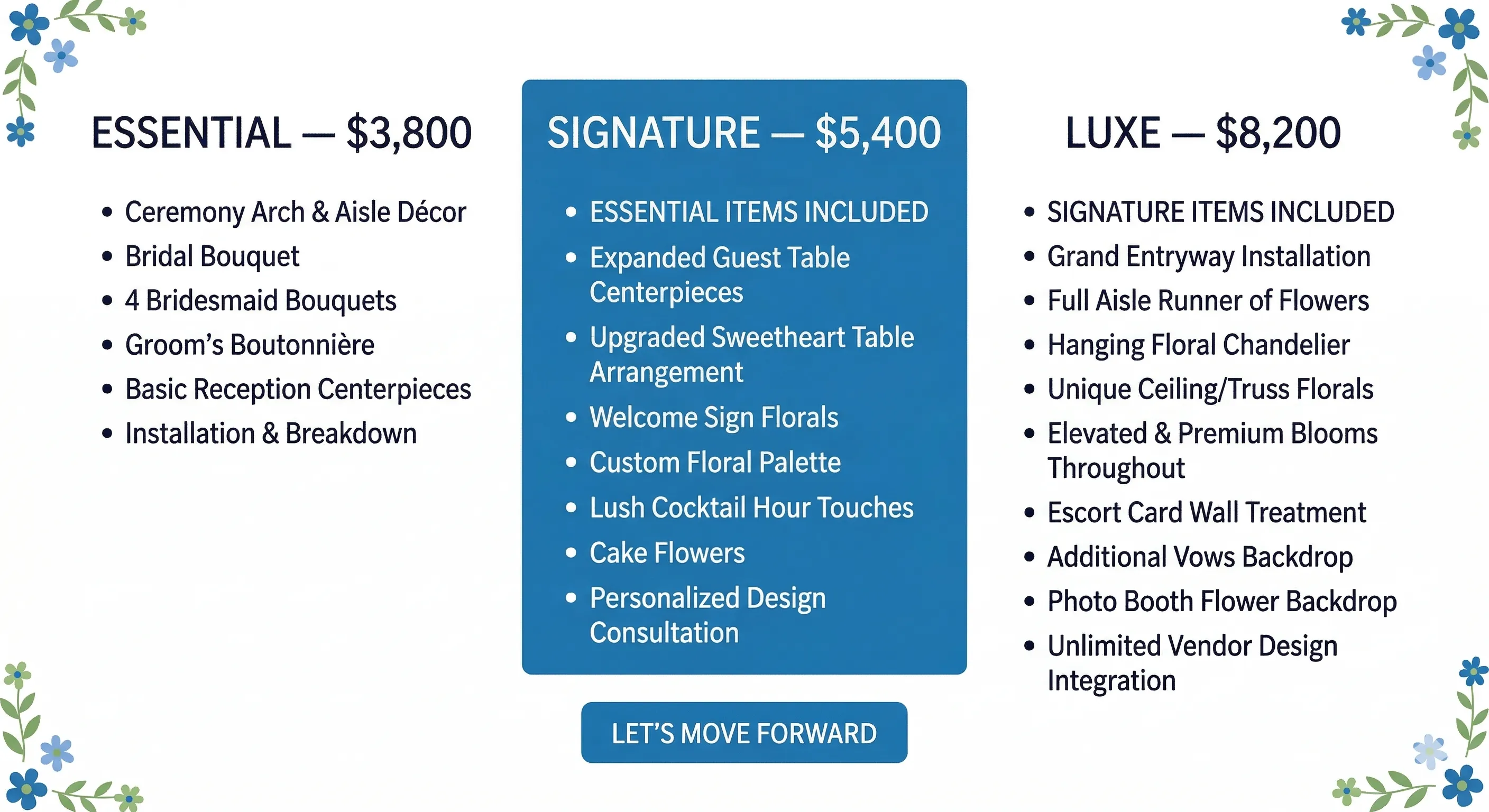
The Essential Tier covers the must-haves — personal flowers (bridal bouquet, bridesmaids, boutonnieres), one ceremony focal piece, and simple reception centerpieces. This tier should be profitable at your standard markup and represents the minimum scope you’re willing to take on for the venue and event size. It’s not a “budget” option — it’s a beautifully executed foundation.
The Signature Tier adds impact — upgraded bloom varieties, more complex centerpieces, additional ceremony elements like aisle treatments or an arch, and possibly cocktail hour arrangements. This is your target tier. It represents what you’d design if the client said “make it beautiful” without constraints. It should be where most clients land, and its price anchoring works because it sits between the Essential and Luxe options.
The Luxe Tier is the full vision — large-scale installations, premium or rare blooms, extended rental inventory, enhanced reception coverage, and the kind of design complexity that transforms a space. This tier exists partly because some clients genuinely want it, and partly because it makes the Signature tier feel like a smart, balanced choice by comparison.
Why Structured Options Convert Better Than Open-Ended Quotes
The power of presenting structured options goes beyond simple psychology. It solves three specific problems that florists face in the sales process.
First, it eliminates scope ambiguity. Instead of the client picking and choosing individual items and then being surprised by the total, each option represents a known investment level. The client chooses the direction first, and the details follow. That reversal — commitment before customization — is what speeds up the decision.
Second, it protects your minimum. By presenting the Essential option as the starting point, you’ve established a floor below which the conversation doesn’t go. Clients whose budget falls below that floor are identified early, before you’ve invested hours of design time. This is far more effective than quoting individual items and then watching the client negotiate them down one by one until the project isn’t worth taking.
Third, it creates a natural path to higher value. Clients who initially lean toward the Essential option often move to Signature once they see what the difference includes. The visual side-by-side comparison does the selling for you — you don’t have to push. The key is giving each option a single, clear price — not a range. “$5,400” is easier to say yes to than “$4,200 to $6,800 depending on final selections.” Ranges create uncertainty, and uncertainty creates delay.
The Proposal Speed Problem
Getting the framework right is only half the battle. The other half is being able to build and send proposals fast enough that momentum doesn’t die between the consultation and the quote.
This is where the tool matters as much as the strategy.
Many florists build proposals in Canva, PowerPoint, or Word. These tools can produce beautiful documents, and there’s nothing wrong with a well-designed Canva proposal for a small-volume studio doing five to ten weddings a year. But as volume grows, the cracks appear quickly.
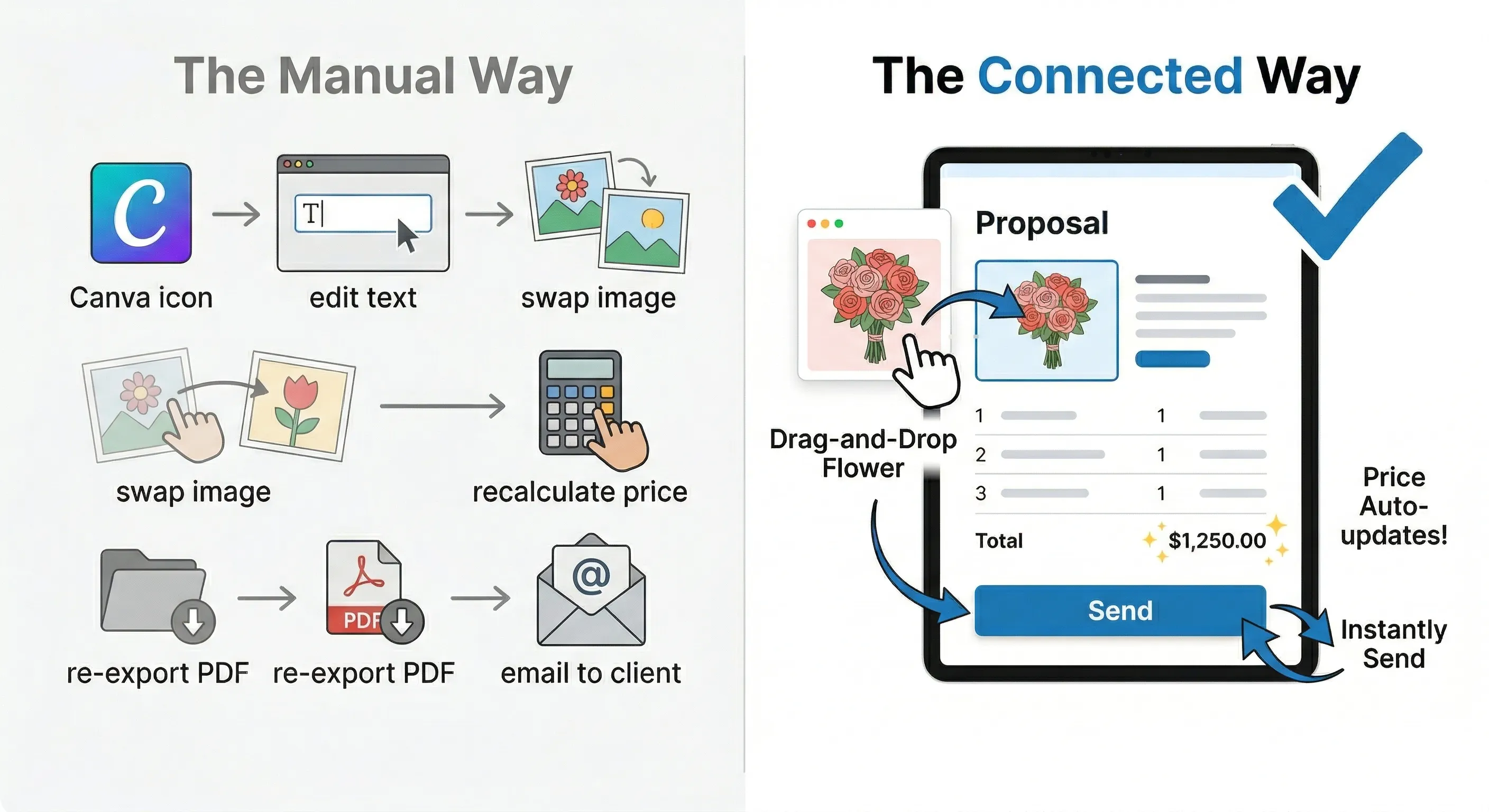
The core problem with static design tools is that every proposal is essentially built from scratch. You can template the layout, but the content — the specific flowers, the pricing, the images, the descriptions — has to be manually updated every time. When the client wants to swap the ceremony arch for a garland, you’re reopening the file, adjusting the image, recalculating the price, updating the description, and re-exporting the PDF. For one revision, that takes 15 to 30 minutes. Across three rounds of revisions on 30 weddings a year, you’re spending 22 to 45 hours just on proposal edits — nearly a full working week lost to copy-paste.
The deeper issue is that these tools are disconnected from the rest of your business. Your Canva proposal doesn’t know what your recipes cost. It doesn’t update when wholesale prices change. It can’t generate a stem count or a shopping list. It doesn’t connect to your contracts, your payments, or your production worksheets. Every piece of information has to be manually transferred from one system to another, and every transfer is a chance for errors — wrong quantities, outdated pricing, a substitution that didn’t make it into the final version.
This is the problem that purpose-built proposal software solves. When your proposals live inside a system that’s connected to your recipes, your pricing, and your workflow, changes happen in seconds instead of minutes. Swap a flower variety and the price recalculates automatically. Add a centerpiece and the stem count updates. The client wants to move from Essential to Signature? One click — and the proposal reflects the new scope, the new price, and the new recipe requirements instantly.
The result isn’t just time saved. It’s faster turnaround, which means faster bookings. Data from Curate users shows that florists using the platform spend 42 percent less time creating initial proposals and 35 percent fewer cumulative hours on the entire sales process compared to other tools. Those numbers translate directly into capacity — more weddings quoted, more bookings closed, without adding staff.
Speed Is the Real Competitive Advantage
Most advice about floral proposals focuses on what goes into them. Not enough focuses on how fast they go out.
Here’s the reality: the window between a client consultation and a signed contract is shorter than most florists think. Couples are often talking to two or three florists simultaneously. The one who gets a polished, clear proposal into the client’s hands first has a massive advantage — not because the client is impulsive, but because speed signals competence. A florist who sends a beautiful proposal within 24 hours feels like someone who has their operation together. A florist who takes a week feels like someone who might also be slow on revisions, slow on communication, and slow on the day of the event.
The tool you use determines how fast you can move.
With Canva or Word, a strong proposal takes two to four hours to build — pulling images, formatting text, manually calculating prices, exporting a PDF, and attaching it to an email. That’s fine for five weddings a year. At 30 or 40, those hours compound into a bottleneck that directly limits how many events you can quote and how quickly you can respond to new inquiries.
Purpose-built proposal software collapses that timeline. With a system like Curate, a designer can build a polished, image-rich proposal in minutes — not hours. Drag in the arrangements, select the stems from your recipe library, and the pricing calculates automatically. The result is a proposal that looks as beautiful as anything built in Canva, but connects to your actual recipes, your actual costs, and your actual workflow.
The Live Link Advantage
But the biggest difference isn’t just build speed. It’s what happens after you send it.
When you send a proposal as a PDF attachment, every revision creates a new cycle. The client asks to swap the arch for a garland. You reopen the file. Edit the text. Recalculate the price. Re-export. Re-email. The client now has two versions in their inbox and isn’t sure which one is current. Three rounds of revisions later, there are five PDFs floating around and nobody is confident they’re looking at the right one.
The better approach is a live proposal link — a dedicated URL for each client’s event that always reflects the most current version. When the client asks for a change, you update the proposal and it’s instantly reflected at the same link they already have. No re-exporting. No re-sending. No version confusion. The client can revisit their proposal anytime and always see the latest version, which means fewer “which version is this?” emails and faster decisions.
This is the model Curate uses. Each event gets its own live proposal link. The client sees a beautiful, interactive proposal — not a static PDF they have to download and scroll through. When something changes, you update it once, and the client sees it immediately.
From Proposal to Contract in One Flow
The other place where the traditional proposal process loses momentum is the gap between “I approve the proposal” and “I’ve signed the contract.” In most workflows, those are two separate steps — the client says yes to the proposal, and then a few days later you send over a separate contract document (or a DocuSign link) for them to review and sign. That gap is where deals stall. Life gets busy. The contract sits in their inbox. A week goes by.
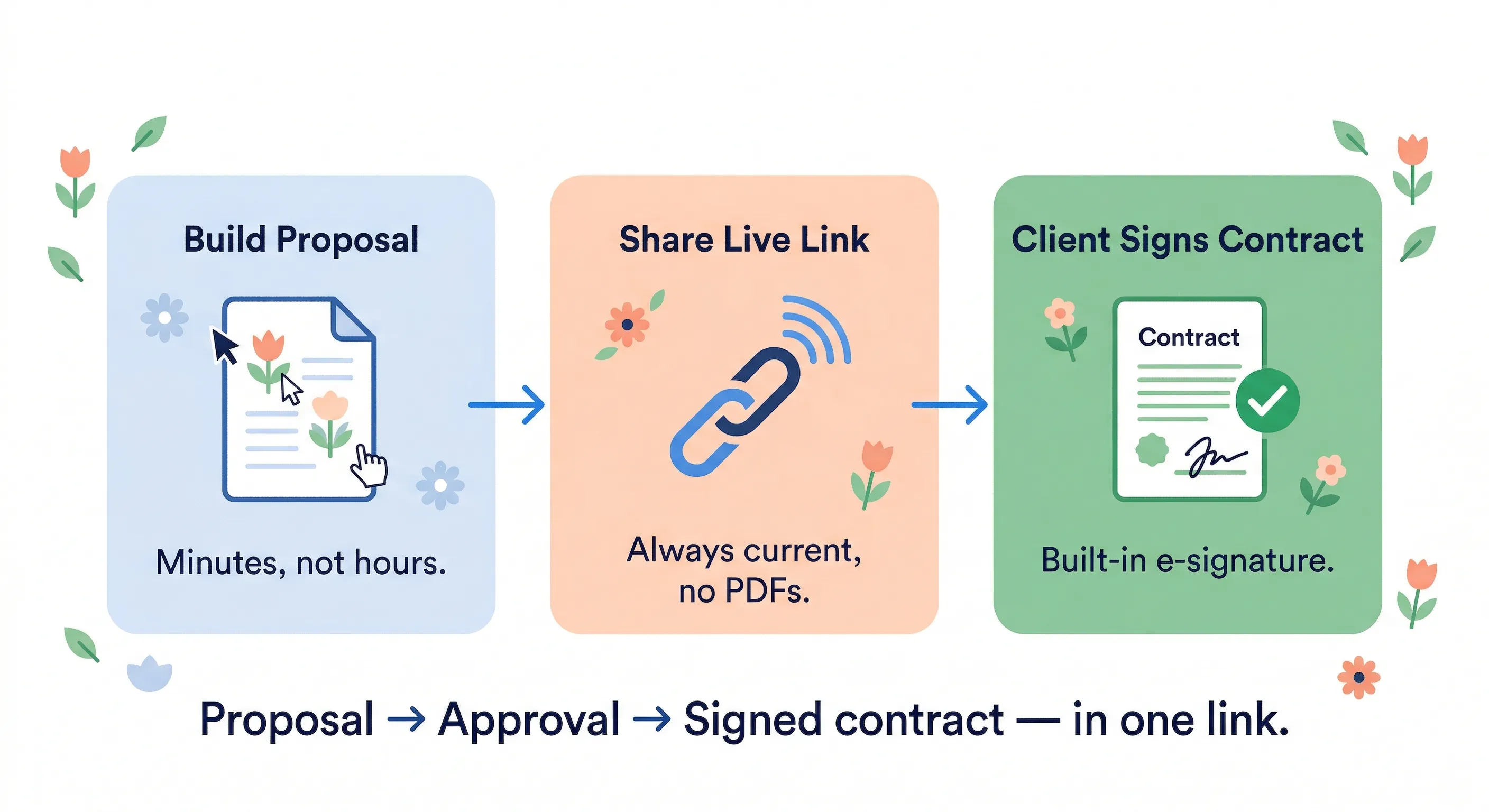
The fastest-closing florists eliminate that gap entirely by building the contract directly into the proposal. The client reviews the proposal, loves what they see, and signs the agreement right there — no separate document, no additional email, no waiting. The contract is embedded in the proposal itself, functioning like a built-in e-signature that captures the approval, the scope, and the payment terms in a single interaction.
Curate’s proposals work exactly this way. The contract lives inside the proposal, so the client can review their floral plan and sign the agreement in one seamless flow. It removes the friction of “I’ll send over the contract separately” and replaces it with “you’re booked” — right now, in the moment when excitement is highest.
The Proposal Checklist
Before you send your next floral proposal, run through this checklist:
Is it structured with clear options rather than a menu of 15 individual line items? Does each option have a single price, not a range? Is there a recommended option highlighted? Are images curated and consistent — not a Pinterest dump but a cohesive visual story? Is the language written for the client (not for another florist)? Can you build and send it within 24 hours of the consultation while excitement is still high? If the client requests a change, can you update it without re-exporting and re-sending? Does the client have a single link that always shows the latest version? Can the client sign the contract directly within the proposal without a separate document?
If the answer to any of those is no, the framework might be right but the execution is creating friction that costs you bookings.
From Proposal to Booked — Without the Gaps
The florists who consistently close at the highest rate share a few traits. They send proposals fast — within 24 hours, not a week. They present options that are clear and complete, not cluttered and open-ended. They give clients a live link instead of a PDF attachment. They handle revisions instantly instead of re-entering revision cycles. And they eliminate the gap between proposal approval and contract signing by keeping the entire flow in one place.
Your proposals should be as polished and intentional as your designs. Because for the client, the proposal isn’t just a price quote — it’s their first preview of what working with you will feel like. If the proposal process is slow, fragmented, and confusing, that’s the experience they expect from the rest of the relationship. If it’s fast, beautiful, and seamless, they’re already confident they made the right choice.
Curate proposals are beautiful, fast to build, and always live. Your client gets a dedicated link that updates in real time — no more re-exporting PDFs and re-sending emails after every change. When they’re ready, the contract is built right in — they can review the floral plan and sign the agreement in one seamless step.